Friday, February 17, 2012

Leonard Cohen Had Sony Pay Pico Iyer & Leon Wieseltier $2,500 Each For These Reviews

LETTERS FOR LEONARD

by
LEON WIESELTIER & PICO IYER

DEAR HEATHER:

"It seemeth to me there is as it were a plague in the house". Those are the mysterious words, from the Book of Leviticus, that the owner of a house addresses to a priest when he notices a strange lesion on his dwelling, and seeks relief from the impurity that is denoted by this wound to his walls. What is so striking about this voice, what struck the commentators about it, is its tentativeness, its imprecision, its uncertainty. It is rare in Scripture that somebody does not know for sure. But this man does not report a plague in his house, he reports his impression of a Leonard Cohenplague in his house. Why? Perhaps his fear has rattled his confidence in his mind. But another explanation (always another explanation!) was given. The point of this locution, so unfamiliar in the biblical universe but so familiar in the human universe, is, in the words of an ancient rabbi, to "teach your tongue to say: ‘I do not know’".
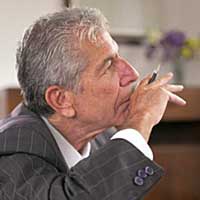
Here endeth the midrash for Dear Heather. But it is precisely from such a tongue that this reflective and lovely and companionable record has fallen. For poets, for artists, for thinkers, there is no more perilous illusion than the illusion of the last word. There is no such thing as the last word, because in another moment the light will change, the page will turn, the caress will end, the ice will melt, the shadow will pass, the glass will break, the news will arrive – the world will no longer look as it did, the world will no longer be what it was, when you wrote or spoke or sang the words that were designed to capture it, and to fix it, and to settle the matter of its meaning once and for all. The ideal of the last word represents only a desire to be released from the variety and the mutability of life, to bring experience and expression to an end. Behind the grandiosity of the last word, the big statement, the final image, the ultimate conclusion – behind all these conceits and coercions lies a sorry exhaustion and a specious authority.

Dear Heather is a retort to such exhaustion and a rejection of such authority. Its achievement is owed to the reduction of its scale. Leonard CohenCohen has always been fascinated by his own smallness: he does not rebel against it so much as he rebels within it. His art has been a long and invigorating endeavor to coax significance out of insignificance. He never introduces anything large or anything lasting except wryly, as if to say: here is what he who does not know knows. And Dear Heather is a perfect document of this brilliant humility. Here the form has caught up with the philosophy. The record is a notebook, a scrapbook, a sketchbook, a miscellany of ideas and moods and observations and diversions -- the definitive declaration of Cohen’s glad loss of interest in the definitive. The temper here is provisional, digressive, incomplete, quiet, experimental, generous, artisanal. Dear Heather is located in the middle of the work and in the middle of the world. Cohen sings, but not always; sometimes he lets others sing (especially Anjani Thomas, in whose preternaturally gorgeous voice Cohen has found the most angelic of all his "angels"), and sometimes he speaks, his own words or the words of others. He wishes to give what he loves a hearing. Even in sadness, he comes to praise.

Leonard CohenThe record revels in its own lack of monumentality. No emotions are exempted from its insistence upon the reality, and the beauty, of the ordinary. Consider "On That Day", Cohen’s contribution to the mourning for September 11, 2001. On the occasion of "the day they wounded New York", he has written a ditty. It is all of two minutes long, and it includes the unplangent twanging of a Jew’s harp. But there is no blasphemy in this simplicity. Not at all. The song is deeply affecting because of its refusal of the temptation of magnitude, and also because of its argument that one may respond to evil with madness or with service. Compare this unlikely commemoration to the bombastic arena-rock threnodies that were provoked by the catastrophe in New York and you will have a lesson in grief’s integrity. Or consider "Dear Heather", the wickedly amusing title track. Here it is not sorrow that is translated into the idiom of the actual, it is desire. A woman walks by a man and undoes him so completely that he must teach himself again to spell. Cohen is tickled by the banality of his own lust. Where anguish once was there now is silliness. The longing persists, but the slavery is over. And the evidence of inner freedom is everywhere in Dear Heather. It is a window upon the heart of an uncommonly interesting and uncommonly mortal man, a man with the stomach for transience. Leon Wieseltier

DEAR HEATHER:

"It’s a leave-taking, with light," I found myself saying, to my own surprise, the first time I listened to Dear Heather. I was sitting in a small cottage in central Los Angeles, looking out on a sunlit garden, flowers, a constant trickle of water from a fountain where birds splashed (the freeway nearby seeming a million miles away), and what I was hearing might have been a transcription of Leonard Cohenthe scene around me. In the past, especially on his last album, Ten New Songs, Leonard Cohen often seemed to push his songs towards darkness and silence, the place where everything gives out. Indeed, the power of that record seemed to me to lie partly in its singleness, its unity of tone, the songs flowing one into the other with a grave, contained intensity. This was the beauty of a small cabin beside a Zen meditation-hall high up in the mountains.

The new record, for me, is the beauty of returning to the world again, celebrating its beauties, even though they will pass. In one of his early songs about the monastic pull, Cohen wrote of how "night comes in," as he goes into the dark to court Our Lady of Solitude; here I feel as if night is receding, as light comes in. The first surprise of the record is how various and almost floral are its musical arrangements, the singer hopping from style to style like a bee buzzing amidst the flowers. The first time I heard the record I imagined a series of objects lined up on a table, all precisely rounded, like brightly colored balls, entire in themselves and lucid, but not pointing to anything beyond themselves. © Anjani ThomasOfferings for a Sunday morning, you could say, at home in the sun.
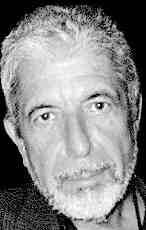
Cohen has suffered more than almost any songwriter or poet alive from assumptions about his life, or at least that shadow-life that is his legend; people seize on the songs with women in them, or using his central (often metaphorical) word "naked," and miss the point often. The second song here teases us with the Cohen we expect--women, naked, crying "Look at me, Leonard." The fact he uses his own name, again and again, is almost a way of stressing that he’s talking about the figure who moves through the world, in rumors, in gossip columns, in listener projections. With that second song, Leonard departs.

The others startle with their sense of completeness -- or, put another way, with their lack of obvious gravitas, their freedom from obvious depth. They’re transparent: notebook entries, or a series of recipes hung up on a refrigerator door. When you expect Cohen to go deeper into a song, to give us a new verse, a different turn, as he’s always done before, he steps back, gives us the same verse again. When you expect him to surprise us, as he’s always done, with an unexpected rhyme, he surprises us by giving us just the word we expect. And often the words more or less dissolve, as the singer experiments with chant, or incantation, the place where music becomes something more than music, closer to prayer or ritual recitation. "And your legs white from the winter."
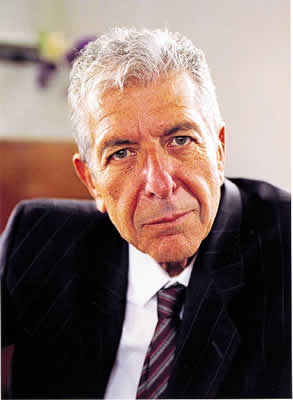
And all the while, his voice, which had already begun to recede from view in Ten New Songs, where Sharon Robinson, his conspirator and co-producer, led on many tracks, fades further and further away from us, until Robinson and Anjani Thomas take over, and replace his dark sonorities with their more light-filled decorations. A ceremony of farewell, in a way.

The first time I listened to this record, I couldn’t help but wonder what listeners would make of it. Many of his fans look for long, gnarled poems from Leonard Cohen, for parables and theological mutterings; they’re not ready for songs as straightforward, and full of fresh air, as a 16th century lyric. He’s giving us here, essentially, jottings, moments, the things he might collect for a letter to a friend. It’s no coincidence, I’m sure--things are precise on Leonard Cohen albums--that, in the C.D. brochure, there are sketches all over the place, simple, whimsical, unfancy, and on many pages the drawings drown out the words.

Anyone who writes knows that transparency is at least as hard to catch as mystery. Mystery means taking on all that is beyond the self (or inside the self); transparency means recording all that is outside the self, and independent of it. Usually, when we describe something, we cloud it over with our thoughts, our projections, our hopes for it, our confusions. Just to give the thing as it is is often the hardest task of all, which is why we admire a Cezanne still life, or a small red wheelbarrow in a William Carlos Williams poem.

It’s also the easiest thing to underestimate, or look past. I can imagine a music critic rejoicing in the way this record -- quite literally, a record of a life, a day -- opens up the palette to admit new colors; but the exegete will be confounded by the fact that the words just stand there, giving up nothing but themselves. There’s no spin on them, no gloss. Cohen has traditionally been the voice of striving, of conflict and seeking; here he becomes something harder for us to accept, a voice of contentment. It’s as if he’s withdrawn his self from things in order to say, "This is what they are. They have no need of me"

When I was trying to grasp this record, elusive precisely because it sits in full view, illuminated, less hidden or in shadow than is usual with Leonard Cohen, I thought of the poems of the Japanese among whom I live. A plover. A temple-bell. A marigold. Observation of the world for them becomes observation of a ritual, even of a religion. Indeed, it is from their straight-on renditions of the world that Pound got his imagism, from which William Carlos Williams took his wheelbarrow. The Zen discipline tells us to look at what’s in front of us, and what’s beneath our feet. No need to search for enlightenment or beauty or analytic wisdom, no need to seek out meaning or depth. It’s all right there, in front of our eyes.
Pico Iyer


Thursday, February 9, 2012

Stephen Gianelli Has A History Of Vehemently Disparaging People

In defense of attorney Chuck Morse

I am writing in support of a pillar in our community, attorney Chuck Morse. Stephen Gianelli, who lives in San Francisco, continues to vehemently disparage Mr. Morse’s reputation in letters to the editor as well as comments on his own letters to the editor (“Judge Wick made proper decision,” Oct. 18).

I have known Mr. Morse and worked with his staff for the past 15 years. He has a flawless reputation and the utmost integrity — fair, honest and above reproach in all matters. He has served honorably and ethically on the boards of directors of the following organizations: Big Brothers of Napa, Aldea Children and Family Services (19 years; president twice for a total of five years), Garden Haven Adult Day Center, Napa Valley Hospice (president), Napa Adult Day Health Care, New Technology High School Foundation, Napa County D.A.R.E. Foundation, Solano-Napa Area Agency on Aging, Matrix Parent Network, Napa ParentsCAN (founding president) and Community Resources for Children.

In addition, Mr. Morse has served on the Land Trust of Napa County Investment and Finance Committee and the Napa County Commission on Aging. He has awards and commendations for pro bono legal services from the State Bar of California, Napa County Superior Court Judges, Napa County Bar Association and Legal Aid of the North Bay.

I would wager that Mr. Morse did exactly what his client, Mr. Fogerty, wanted him to do. We need more attorneys like him.

Methinks this Mr. Gianelli doth protest too much.

Paula Belden / Napa

Copyright 2012 Napa Valley Register.


Read more: http://napavalleyregister.com/news/opinion/mailbag/in-defense-of-attorney-chuck-morse/article_e478ae44-ff8c-11e0-b720-001cc4c03286.html#ixzz1lv6WsUqT

Tuesday, February 7, 2012

Sprocket's Details Of The Reporters At LA Superior Court Explains Why No One Bothered Investigating The Set Up

February 6th, 2012

When I get up on the 9th floor, there’s a huge line waiting for the
security station to open up. Most of the mainstream media has arrived
before me. Some members of Lazarus’ family are here as well as
Rasmussen’s. My friend Katie is here along with her friend Lisa. I’m
not worried about getting a seat, I’m just worried about “which” seat.
I had a hint on Friday that the media would be in the first row. I am
surprised by this because usually, the family sits in the front row.

The station is opened and we file into the hallway. The reports form
little groups, chatting with friends or greeting colleagues they
haven’t seen in a long time. I hadn’t seen Los Angeles Times reporter
Andrew Blankstein since the Robert Blake trial in 2005 when I was
still just a member of the general public. I give him a big smile and
pointing to my press badge I say, “Can you believe it?”

I try to inconspicuously point out to some members of the press and my
friends who various people are on each side of the case. My face
lights up when I see Steven Mikulan and I give him a big hug. Steven
was with the LA Weekly for 20 years but is now with Los Angeles
Magazine. I also met Steven at the Blake trial and he’s been a friend
ever since. The Public Information Office (PIO) staff tell the press
with passes to start lining up. My name is called fourth and I’m
surprised that I will be in the front row. Usually, the victim's
family is placed in the front row. In front of me is the sketch artist
Mona, another sketch artist and Investigation Discovery’s Pat LaLama.
Behind me I meet Ann O’Neill, with CNN. When I introduce myself she
tells me she works with Beth Karas and has read my blog. I immediately
thank her. It’s still quite a shock to hear that the mainstream media
is reading what I write.

Although my seat is in the front row, it’s not a great seat. I’m too
near the jury. I think I will forever be affected by that time in
Judge Fidler's court room where I was accused of speaking so loud in
the gallery (I did receive an apology.) that the jury heard me, so I
don't like to be too close to them. For me, my ideal seat is sitting
right in line with the witness box but the podium is directly in front
of it in this courtroom. That's where legendary writer Dominick Dunne
liked to sit.

Dateline produce Robert Dean is here, Matthew McGough, Miram
Hernandez, Patrick Healy and AP reporter Linda Deutsch. Linda is such
a respected institution herself, she tells the PIO ladies where she’d
like to sit: second row on the aisle. When we’re let into the
courtroom, Pat and Mona are talking about DDA Shannon Presby. Pat is
certain that Presby had a career as a child actor and she wants to ask
him about that. I see a few people from the DA’s office in the back
row as the courtroom is packed with as many people as the PIO can
fill. The victim’s family is sitting right behind me. Lazarus’ family
is sitting on the right side of the courtroom, behind the bailiff’s
desk. I see Steven Mikulan wrangled a seat even though he wasn’t on
the media list.

It’s 8:40 am and counsel finally arrive. The detectives on the case
are sitting directly behind the prosecution table. There is a small
narrow table in front of them covered with case file materials. I’m
trying not to listen in on Pat and Mona’s conversation about
restaurants. It’s then I note that Pat is a lefty like me and she has
very interesting handwriting. Many of the letters are written in a
flamboyant style. I have a hard time pulling my eyes away from her
spiral notebook. Nels and Loretta Rasmussen are sitting almost
directly behind me, their attorney John Taylor beside them.

Sprocket's Trials & Tribulation Blog

Phil Spector Untitled Biopic - 2010

Full cast and crew for
Untitled Phil Spector Biopic (2012) (TV) More at IMDbPro


Directed by
David Mamet


Writing credits
David Mamet
(screenplay)

Cast

Al Pacino ... Phil Spector

Helen Mirren ... Linda Kenney Baden

Jeffrey Tambor ... Bruce Cutler

James Tolkan ... Judge Fidler

Martin Jarvis ... Nigel

Matt Malloy ... Dr. Spitz

David Aaron Baker ... Alan Jackson

Kate Blumberg ... Woman #1

Jack Wallace ... Old Musician

Yolonda Ross ... Kelly

Tom Stratford ... Los Angeles County sheriff

Mary B. McCann ... Newscaster #2

Bob Jennings ... Jumpsuit Man

Naeem Uzimann ... Buisness traveller

Vernon Campbell ... Bodyguard #2

Joey Auzenne ... Bellhop (rumored)

Clara Mamet ... Paint Girl

Stephen Tyrone Williams ... Reporter

Lauren Schacher ... Reporter

Peter Conboy ... L.A. Country Sheriff

Jenn Lyon


Matthew Rauch ... Mike

Jordan Lage ... Mike

John Pirruccello ... Nick Stavros

Lizza Monet Morales ... Irene

David Gerson ... Interviewer

Cynthia Silver ... Woman #2

George Peck ... Courtroom Attorney

Alfredo Narciso ... Assistant

Philip Martin ... James Lee
Neil Pepe ... Interviewer

Jonathan Forte ... Lead Singer

Ella Dershowitz ... Paralegal

Meghan Marx ... Lana Clarkson

Angel Dillemuth ... Valet

Gail Silver ... Focus Group Woman #2

Kimko ... Mock Bailiff
Stevan Lee Mraovitch ... Adriano De Souza

Adalgiza Chermont ... Focus Group Woman #1 (as Adalgiza Chemountd)

Rick Toscano ... Young Phil
Grim Reaper Q. ... Bodyguard #1

Don Gomez ... George Bodyguard
Tatiana Godfrey ... Bailiff
Tatiana Godfrey ... Bailiff (rumored)

Sunday, January 22, 2012

Leonard Cohen - Old Ideas - Rolls Out Phil Spector And Kelley Lynch To Maximize The Return On Our Suffering

Monday 23 January 2012


Leonard Cohen: the maestro who’s made the most of his misery

Even on the release of 'Old Ideas' – his 12th album – the 77-year-old singer-songwriter Leonard Cohen remains happy to be sad, says William Langley

Leonard Cohen, a voice deeper than a Siberian coalmine
Trim and dapper, Leonard Cohen today has the look of an ageing mob lawyer, with a voice once described as 'deeper than a Siberian coalmine' Photo: SPRINGS

"I’ve got no future, I know my days are few,” gasps Leonard Cohen on his latest album. It’s this kind of cheeriness that has earned the singer-poet the nickname Laughing Len – not to mention the Prince of Pessimism, the Godfather of Gloom and the Maestro of Melancholy. But, while looking on the dark side has served him well over the years, there are worrying signs that now, at the age of 77, he’s getting serious.

To some extent, Cohen’s unhappiness is understandable. He has had a tough life, both before and after he became famous. Anyone who has had a gun held to his head by Phil Spector, had his entire career earnings embezzled by an allegedly crooked manager, and been given the middle name Norman has plenty to feel resentful about.

In London last week, for the launch of Old Ideas, his 12th studio album, he showed few signs of cheering up. The critics were generally agreed that this was a very good thing. One praised the latest work as “a mix of suffering, heartbreak and darkness”, and another as “a characteristically intimate reflection on love, death and suffering”. Cohen, rarely given to commenting on his own work, confirmed: “I’ve come to the conclusion, reluctantly, that I’m going to die. But, you know, I’d like to do it with a beat.”

Perhaps we should be grateful that he has lasted this long. His splendidly unglued life has been largely spent, as one of his support acts has quipped, “sitting in airports waiting for buses”. He has come through breakdowns, bereavements, traumas, court appearances and separations, and sought help through drugs, religion and self-analysis. In the late Seventies, he made an album with the deranged producer Phil Spector, and later recalled: “One night, Phil approached me with a bottle of kosher red wine in one hand and a .45 in the other, put his arm around my shoulder, shoved the revolver into my neck, and said, 'Leonard, I love you.’ I said, 'I really hope you do, Phil.’”

While all this surely eases the job of making music for people to slit their wrists to, it doesn’t make it any easier to be Leonard Cohen. One of the reasons he rarely gives interviews is the difficulty of addressing the core conundrum that he had never intended to be a pop singer – and, having become one, can’t give it up.

This is no trouper’s tale. In her autobiography, the folk singer Judy Collins recalls having to practically manhandle Cohen onstage at his debut American concert in 1967. “I can’t do it,” he said, “I would die from embarrassment.” Halfway through his opening number, Suzanne, Cohen got the jitters, unstrapped his guitar and walked off again. “I can’t do it, I can’t go back,” he told her. “But you will,” she said, and, willingly or otherwise, he has been doing so ever since.

Today, he is a relatively polished stage performer, trim and dapper, with the look of an ageing mob lawyer in his charcoal suit and fedora. The voice – once described as “deeper than a Siberian coalmine” – is now deeper still and roughened by age, but it arguably suits the material. When Cohen needs some vocal variation, he can call on others, as he did in recruiting Britain’s Webb Sisters for a world tour and his Live in London album.

What he hasn’t got much better at is explaining what these dark, reproachful, sometimes caustic songs are really about. Cohen likes to deflect such questions, either by using Yeats’s line about “the foul rag and bone shop of the heart” or arguing that the “sacred mechanisms” of songwriting simply don’t lend themselves to explanation. You can understand his reticence when something like Hallelujah, an oddball song on a flop album, ends up as a soundtrack to The X Factor.

Most fans agree that the repertoire’s central theme is disappointment. It isn’t hard to spot where it comes from. Cohen was born in Montreal, the son of middle-class, observant Jewish parents. He thinks his early years were happy, but, when he was nine, his father, Nathan, who ran a clothing store, died suddenly. The boy took solace in books and especially poetry, and after leaving McGill University set out to become a full-time poet.

The next big blow was discovering the difficulties of making such a career choice pay. His first poetry collections, and two early novels – The Favourite Game and Beautiful Losers – sold poorly, although the latter would gain some fame when its core sex scene was voted the worst in the history of Canadian literature.

Growing disillusioned with the world of letters, he headed to New York with the vague idea of becoming a singer. There, he fell in with Andy Warhol’s Factory, a smacked-out salon of waifs, aesthetes and famous-for-15-seconds nobodies that fortunately numbered some talents, too – notably the Velvet Underground, filmmaker Paul Morrissey, and the poor, doomed model-cum-muse Edie Sedgwick. Cohen could see the difference and understood what it would take to succeed.

The odds remained against him. He was already in his early thirties, and pop promoters tended to ask: “Aren’t you a little old for this game?” He wasn’t good-looking, couldn’t sing very well and had no obvious charisma. The breakthrough came when Judy Collins, whom he had met in a club, agreed to record his composition, Suzanne. In 1967, The Songs of Leonard Cohen was released, keying perfectly into the fashionable singer-poet genre established by Bob Dylan and Joni Mitchell. Unsettling, literate and beautifully phrased, the record made Cohen a star.

All these years later, he remains one. Each attempt to retire has been thwarted. For several years in the Nineties, he vanished into a Zen monastery in California, but emerged in 2000 claiming that he had beaten depression and was keen to work again. He soon changed his mind, but in 2005 discovered that more than

$5 million in earnings had vanished from his bank accounts. He won a civil suit against his former manager Kelley Lynch, but failed to recover the money, and was forced to return to work. He has never married, listing matrimony as high among his phobias.

However few days he claims to have, they’ll be spent like last week’s – pleasing, teasing and worrying the fans. Success, he says, is survival, and he currently has both ends covered.