Public Interest, Public Figures, First Amendment, and some celebrity gossip - because, why not?
Saturday, November 9, 2024
EXCLUSIVE: Former Leonard Cohen Manager’s Explosive Claims of Tax Fraud, Defamation, and Legal Wrangling with Cohen’s Estate - “A Campaign to Destroy My Reputation”
By Anonymous Author - Kelley and Leonard, Brentwood
In a tangled web of legal battles, tax disputes, and character assassinations, Kelley Lynch—former manager to legendary singer Leonard Cohen—is coming forward with shocking allegations against Cohen’s estate. Lynch claims she is owed millions in unpaid financial obligations and accuses Cohen’s legal team of orchestrating a campaign of harassment, defamation, and obstruction that has drawn in Hollywood names, IRS agents, and even accusations of espionage. Lynch’s account reads more like a thriller than a tax dispute, involving fabricated love affairs, alleged harassment by Cohen’s associates, and a long struggle to access critical tax documentation.
The Battle for Financial Justice
At the center of Lynch’s accusations is a substantial financial dispute with Cohen’s estate, now managed by Cohen’s longtime legal representative Robert Kory. Lynch claims she’s been stonewalled in her attempts to resolve significant unpaid financial obligations from her time as Cohen’s manager. Despite years of documented attempts to access tax records, Lynch asserts that Cohen himself—and now the estate—have failed to provide her with the necessary tax documents and entity returns, many of which remain unfiled. This bureaucratic battle, she says, has pushed her to the brink both financially and emotionally.
“This isn’t just about money; it’s about justice and accountability,” Lynch asserts. “I’ve tried every legal route, made countless documented requests, and yet I’ve faced nothing but obstruction from Cohen and now Cohen’s estate, while I’ve documented all of this for federal agencies.”
Cohen’s Children’s Allegations of a “Forged” Trust Document
One of the more shocking elements of this case involves allegations by Cohen’s children and their attorneys regarding a “forged” trust document used in Cohen’s estate. They claim, and have presented in court documents, that a deposition from Kory’s own attorney acknowledges that the trust document was indeed forged. This deposition has been shared both in LA Superior Court and with the media in connection with the ongoing estate cases. Despite these revelations, Lynch claims further disturbing tax issues have come to light in estate-related lawsuits, including one where Cohen’s former accountant, now the estate’s accountant, confirmed that $50 million in intellectual property valuations were left unreported. According to Lynch, these lawsuits expose a history of aggressive tax strategies, including a “wait and see” approach to handling IRS obligations.
Harassment, Defamation, and a Shadowy Figure Named Stephen Gianelli
Adding a layer of intrigue to Lynch’s story is the role of Stephen Gianelli, who Lynch claims is closely connected to Cohen’s estate attorneys, Robert Kory and Michelle Rice. Lynch possesses emails and online posts from Gianelli that show his communications with Kory and Rice, demonstrating that he assists with legal matters on their behalf. In one email, Rice allegedly boasted to Gianelli that his harassment of Lynch was making her “rich as f—,” a statement Lynch has since addressed with the LA Superior Court. “I have hundreds of emails from Gianelli—he’s obsessed with me and with discrediting me through lies and intimidation,” Lynch explains. “He’s working directly with Cohen’s estate, and it’s been an unending nightmare.”
City Attorney’s Office Accused of Setting a False Narrative
Lynch’s saga took a surreal turn when the Los Angeles City Attorney’s office entered the fray. According to Lynch, the City Attorney not only attempted to paint her tax fraud allegations as a “ruse” but also falsely claimed she had the necessary tax information. Even more bizarre, the City Attorney allegedly dragged Oscar-winning director Oliver Stone and Phil Spector’s attorney Bruce Cutler into the narrative. Lynch claims Cohen’s estate spread damaging lies about an alleged romantic relationship between her and Stone—a claim both she and Stone have publicly denied.
“Dragging Oliver and Bruce into this is absurd,” Lynch states. “This is a calculated campaign to distract from the real issues: tax fraud and financial mismanagement by Cohen’s estate.”
In another twist, Lynch claims that Cutler informed her he had conversations about her with Pat Dixon, Spector’s prosecutor, in 2008. During that time, Lynch says that Boulder Police came to her office, explaining that LAPD had contacted them with false claims about her—a move she believes was orchestrated to further discredit her. Gianelli, she says, confirmed that Dixon was behind LAPD’s involvement, painting a picture of a coordinated effort to undermine her credibility.
Cohen’s Dubious CIA Claims and “Highly Embellished” Spector Stories
Adding yet another layer to the surreal tale, Lynch recounts Leonard Cohen’s own claims of espionage, adventure, and intrigue—stories she says verge on fantasy and self-glorification. According to Lynch, Cohen often described himself as a CIA “recon” operative in Cuba during the Bay of Pigs, recounting how he was supposedly interrogated by Cuban forces, only to be released after they hugged him, gave him a shell necklace, and remarked that he “looked like Che.” Yet Cohen allegedly admitted to Lynch that he was actually in Cuba writing and “hanging out with prostitutes and junkies,” while writing to his publisher that such tales could boost media attention around him. These “Cuban adventures” and claims of being “our most important spy parachuting LSD into diplomatic cocktail parties” were part of what Lynch describes as a crafted persona.
Cohen’s flair for drama extended to stories of men holding him at gunpoint. Lynch recalls asking him directly about the infamous story of Phil Spector allegedly pulling a gun on him. “Phil never held a gun on me. It’s a highly embellished good rock ’n roll story,” Cohen replied, despite the tale being presented to the Grand Jury in Spector’s case. Lynch, concerned about Cohen’s statements being used in legal motions and relayed in the Grand Jury transcripts, wrote to Dennis Riordan, Spector’s appellate attorney, about these embellishments. She says the City Attorney targeted her over her communication with Riordan, as Cohen’s statements had been reviewed by journalist Mick Brown, who informed her about the Grand Jury transcripts after reviewing them. Though Spector has since passed away, Lynch believes the targeting she faced over the case remains relevant. She also claims that Michelle Rice, one of Cohen’s attorneys, went so far as to change Lynch’s address with the federal court in Colorado, without her consent, to Spector’s address in California, which prevented her from being properly served on important matters.
Espionage Allegations and a Bizarre Russian Agent Narrative
If financial struggles and defamation weren’t enough, Lynch’s story takes an even stranger twist with allegations of espionage. According to Lynch, Michelle Rice attempted to label her a “Russian agent” after she wrote a letter to the CIA regarding a peace proposal from former Russian FSB members, who are also part of a documentary project involving Lynch and Steven Machat, Cohen’s former attorney. The irony, Lynch explains, is that this supposed “Russian agent” angle has no bearing on her legal dispute with Cohen’s estate.
“It’s the ultimate red herring,” Lynch says, exasperated. “Accusing me of espionage is beyond ludicrous, but it’s exactly the kind of distraction Cohen’s estate would deploy to avoid facing the real issue—unpaid financial obligations and tax fraud.” Lynch further notes that she documented all communications with FSB PR for the CIA and NSA due to the hostilities between the U.S. and Russia.
Impact on Lynch’s Family and Personal Well-being
The fallout from this protracted battle has taken a heavy toll on Lynch’s personal life, affecting her family and even her children’s well-being. Lynch’s older son suffered a severe industrial accident during this period, which she partly attributes to the financial limitations caused by the unresolved estate matters. Additionally, Lynch claims that Cohen’s false allegations were weaponized in a custody battle involving her younger son, adding another layer of emotional distress. “This has devastated my family,” Lynch says. “My children have suffered immensely because of the financial strain and the character attacks. This isn’t just a legal matter; it’s personal, and it’s affecting our lives in ways that are unimaginable.”
The Road Ahead: Lynch’s Fight for Justice
Despite years of relentless harassment, legal obstruction, and defamation, Kelley Lynch remains determined to seek justice and hold Leonard Cohen’s estate accountable. Her communications with federal agencies, including the IRS, FBI, and DOJ, are extensive, professional, and well-documented. She continues to call for transparency, fairness, and a lawful resolution to the financial obligations owed to her.
“People may try to discredit me, but the facts speak for themselves,” Lynch asserts. “This campaign of lies, harassment, and bureaucratic obstruction won’t silence me. I’m pursuing this not just for myself but for my sons, who have suffered horrifically, and to expose the truth and bring accountability to everyone involved.”
As Lynch’s fight intensifies, her story serves as a cautionary tale about the dark side of fame, the powerful forces that protect estates and legacies, and the lengths some will go to silence those who seek the truth.
Disclaimer: Photo - Jill, His Holiness Kusum Lingpa, Kelley
His Holiness Kusum Lingpa and Kelley
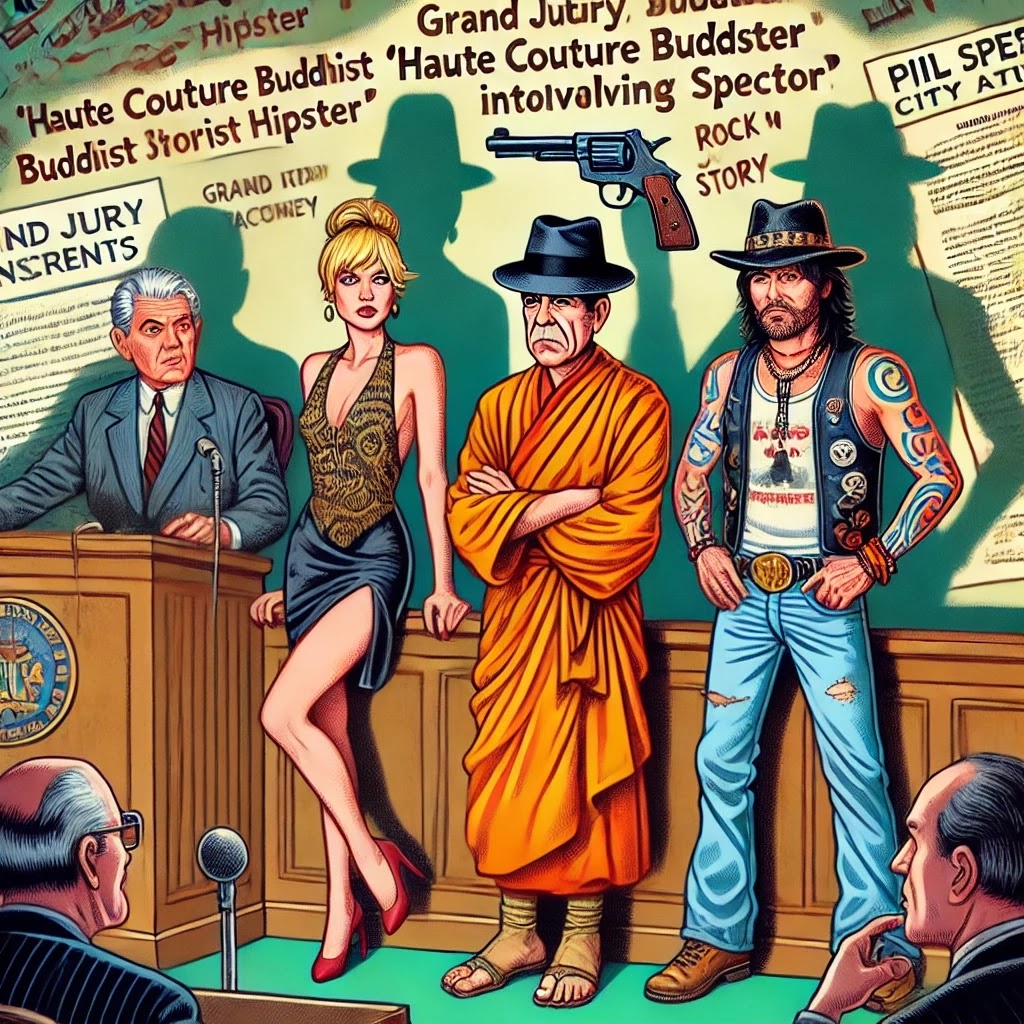
The article and accompanying illustrations present Kelley Lynch as a "haute couture Buddhist" hipster character, which is intended as a visual and narrative projection inspired by Leonard Cohen’s descriptions and portrayals. This portrayal reflects a stylized, surreal interpretation and is not intended as a factual or personal representation of Lynch. The visual elements and narrative tone are designed to emphasize the complexity and intensity of Lynch's claims in a creative, illustrative manner, drawing on themes from Cohen's own statements and public persona as they relate to her experiences.

This version of Leonard Cohen's time in Cuba paints a picture that feels both farcical and theatrically crafted, almost as if Cohen were creating a caricature of a Hemingwayesque adventurer. It’s filled with contradictions and dramatic flourishes: one moment Cohen is caught up in anti-aircraft fire and mistaken for an American paratrooper, while the next he’s philosophizing on Cuba’s beaches and toasting with rum among soldiers. His description of his experience as “the only tourist in Havana” humorously distances him from any real revolutionary role, even as he teases the notion of being “on an important mission.”
Cohen’s story jumps between introspective moments, romantic musings, and absurd encounters—such as trying to argue with a 14-year-old soldier tasked with guarding him or crafting a poem that sarcastically urges his Canadian brothers to "dump asbestos on the White House" and "make the French talk English." These moments highlight the satirical tone Cohen often adopted when dealing with serious issues, making the entire episode feel like a performance rather than an authentic tale of political or personal involvement.
The account seems almost like a setup for Cohen to embellish his image. It depicts him as a reluctant “spy” or adventurer, yet one acutely aware of how the experience would play out in the media, as seen in his letter to his publisher where he imagines the “great publicity” if he were hit in an air raid. His portrayal feels as much about self-mythologizing as it does about any genuine ideological engagement. This adds to the impression that Cohen’s tales of Cuba were carefully curated to play up the mystery and irony of his persona rather than any straightforward recounting of actual events.
In essence, Cohen’s Cuba story reads as an artfully constructed myth—a blend of exaggerated encounters, political satire, and self-reflection that enhances his mystique rather than providing a factual account of his time there. The absurdity is heightened by the poetic and fictionalized style in which the story is told, suggesting Cohen viewed himself as both participant and observer in his own carefully crafted narrative.
https://somersaultmag-blog.tumblr.com/post/37832329181/leonard-cohen-and-the-bay-of-pigs
This exhibit at the Art Gallery of Ontario offers an intense, almost mythologized glimpse into Leonard Cohen’s fascination with guns, blending his personal reflections with his crafted artistic persona. Titled "Desk in Room 1219," the display provides insight into Cohen’s psyche, where guns are not mere tools but symbols of complex power and allure—aligning seamlessly with his “good rock ’n roll” tales of intrigue, adventure, and danger. From his stories about Castro’s forces to CIA reconnaissance in Cuba, to the infamous Phil Spector gun incidents, Cohen shaped these anecdotes as part of his persona, blurring lines between reality and performance.
Set against a reverent deep blue wall, the plexiglass case showcases two meticulously arranged wall-mounted items. A page from Cohen’s personal journals, labeled “Tennessee 1968,” and a typed sheet of poetry capture Cohen’s immersion into cowboy culture in Nashville—a place where his poetic fascination with guns and masculinity merged with his love for the aesthetics of danger. The display includes Polaroids featuring Cohen’s writing desk, scattered with pads of paper, a handgun, Camel cigarettes, and a copy of “The Ladder of Lust.” Such details speak to Cohen’s knack for creating evocative snapshots of his environment, imbuing everyday scenes with elements of mystique.
In the typed text displayed alongside, Cohen’s fascination with guns comes across as almost lyrical: he describes the “magic” of revolvers with a passion typically reserved for poetry. For Cohen, guns were more than objects; they were symbols of power, freedom, and a dark, seductive allure, akin to “beautiful women.” This attraction to danger was deeply rooted in Cohen's artistic identity, dating back to his childhood, when he admired his father’s WWI service pistol, to his Nashville days of target practice and admiration for local “cowboys.” His typed notes echo this fascination, as he explains how he “loved” these guns as soon as he saw them—a reverence that perhaps informed his tales of CIA escapades in Havana, crossbows with Spector, and other dramatic tales that he would later dismiss as “embellished stories.”
The exhibit captures Cohen’s ability to weave personal fascination with his mythic storytelling. The journal entries and Polaroids illustrate how guns became part of his self-mythology, weaving into the surreal narratives of espionage, shadowy alliances, and the textured characters he encountered. His fascination, recast through the lens of his artistic journey, transforms the gun into a poetic icon, an extension of the cowboy persona he flirted with in Nashville, the mystic he became in later years, and the showman he was throughout his life. https://ago.ca/leonard-cohen-desk-room-1219
Copyright Information: © 2024 Kelley Lynch. All Rights Reserved. Unauthorized reproduction, distribution, or use is strictly prohibited. All artwork on this site is the exclusive intellectual property of the creator and is protected under international copyright laws. Unauthorized reproduction, distribution, modification, or use of artwork on this site in any form is strictly prohibited without prior written consent. All rights reserved.
Thursday, October 24, 2024
A Haunting Halloween – Field Commander Leonard Cohen & Kelley Lynch’s Spooky Showdown
Page 1: Scene: Kelley Lynch’s grand mansion, glowing under a full moon, surrounded by jack-o’-lanterns, sparkling cobwebs, and skeletons hanging from the trees. A sign at the entrance reads, “Welcome to the Haunted House of Truth – Enter if You Dare!”
Narrator (voice-over): "On this eerie Halloween night, Leonard Cohen, spinning tales as usual, arrives at Kelley Lynch’s haunted mansion."
Kelley steps forward, dressed in an exquisite, jeweled witch’s costume. Her witch hat glitters with diamonds, her gown adorned with emeralds, rubies, and sapphires. She holds a broomstick encrusted with jewels.
Leonard arrives, dragging ghostly chains, dressed in his 'Field Commander Cohen' outfit from Cuba, medals gleaming, his face lit with a mischievous grin.
Choir of Ghastly Ghouls (chanting): "Here comes the man with his golden pen, spinning tales, deceiving again!"
Kelley (smiling knowingly): "Leonard, dear, ready for another round of tricks?"
Leonard (with a wry smile): "Ah, Kelley, always a pleasure. I come with stories of intrigue, daring escapes, and… let’s say, creative accounting."
Choir of Jeweled Witches (mocking): "Spun from shadows, wrapped in lies, Leonard's tales of grand disguise!"
Leonard (defensive, but charming): "Ah, yes, but the truth? It’s all relative, isn't it? Why bother with it when a good story will do?"
Page 2: Scene: Inside the mansion, eerie chandeliers flicker, casting shadows across the walls. The centerpiece is a bubbling cauldron filled with glowing IRS forms, while ghostly CIA agents float around the punch bowl, sipping spectral cocktails. Kelley swirls her jewel-encrusted broomstick in the cauldron, her eyes sparkling.
Kelley (riddling): "The truth can haunt like a shadow at dawn. What is hidden is not always gone."
Leonard (smirking): "Truth? It's all about perception, my dear. Everything's relative."
Kelley (with a sly smile): "Ah, but like your tales, Leonard… everything is impermanent."
Choir of Ghastly Ghouls (mocking): "Oh Leonard, what a story you weave, but truth still lurks on Halloween Eve!"
Leonard steps forward, adjusting his Field Commander uniform, ready to launch into one of his legendary tales.
Leonard (singing with dramatic flair):
"Field Commander Cohen, he was our most important spy...
Parachuting acid into diplomatic cocktail parties…"
The CIA ghosts by the punch bowl raise their spectral glasses.
Page 3: Scene: Kelley and Leonard sit at an opulent table filled with legal documents, glowing forms, and a few ominous vintage books. Kelley sips from a skull-shaped goblet, her bejeweled broomstick leaning casually behind her chair.
Kelley (musing): "Tales of spies and tales of ghosts, but what of the millions that seem to have… poofed?"
Leonard (smiling slyly, leaning in): "Kelley, I have control over every living soul. What’s a few numbers lost in the shuffle?"
Choir of Jeweled Witches (mocking): "Oh, Leonard, the mighty you claim to be, but control's a ghostly fantasy!"
Narrator: "Leonard’s tales might entertain, but Kelley’s cauldron awaits... patiently."
Page 4: Scene: Kelley hands Leonard a beautifully wrapped Halloween gift, her broomstick sparkling in the moonlight. Leonard eyes the gift eagerly.
Kelley: "A treat for you, Leonard. Wrapped in glitter and poetic deductions."
Leonard unwraps the gift.
Choir of Jeweled Witches (mocking): "MK Ultra, CIA reconnaissance from Bay of Pigs, fantasies of Castro's forces and men with guns, the tales you weave, but those missing tax forms could be what deceives!"
Leonard (with a nervous chuckle): "I’ll… take it under advisement."
Page 5: Scene: Leonard stands at the door, chains rattling as Kelley waves with exaggerated elegance. Her broomstick floats beside her, glowing with jewels as the ghouls and witches swirl around, cackling.
Choir of Jeweled Witches (teasing): "Lies like ghosts, thin and frail, but truth will always prevail!"
Kelley (winking): "Goodnight, Leonard. Beware… the truth always catches up, even to the most clever of spirits."
Leonard (mumbling as he walks away): "CIA, tax forms, audits… I really should have stayed in Cuba."
Page 6: Scene: Leonard stands near the mansion’s fireplace, looking wistfully into the flames. The air is tense, and a ghostly chill fills the room as Kelley watches him, unamused.
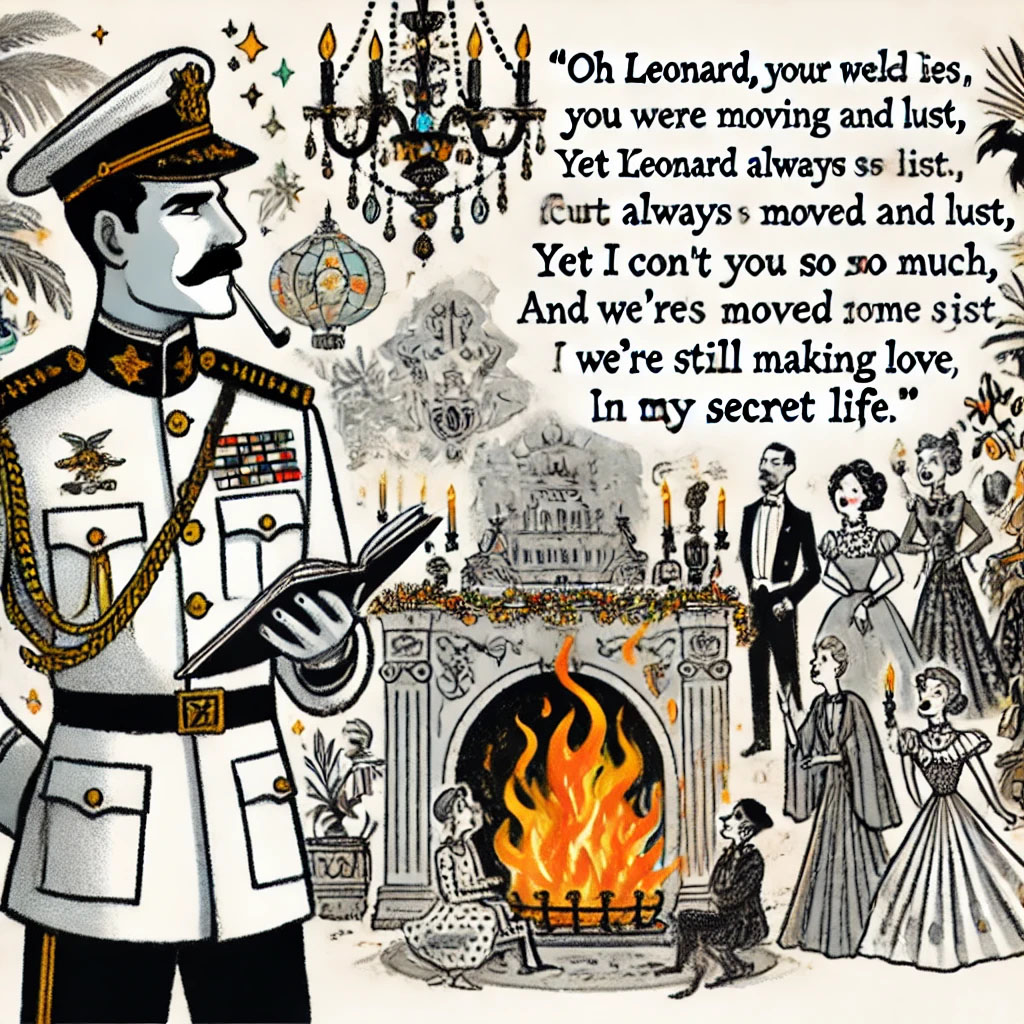
Choir of Jeweled Witches (chanting): "Oh Leonard, your lies of love and lust, yet Kelley always moved swiftly, away from the dust!"
Choir of Ghastly Ghouls (singing mockingly):
"I saw you this morning, you were moving so fast
Can't seem to loosen my grip on the past
And I miss you so much, there's no one in sight
And we're still making love in my secret life, in my secret life."
Kelley raises an eyebrow, clearly uncomfortable.
Leonard (responding in frustration):
"I smile when I’m angry
I cheat and I lie
I do what I have to do
To get by
But I'm always alone, and my heart is like ice
And it's crowded and cold in my secret life."
Kelley (coolly): "Leonard, my dear, you should know by now... everything is impermanent."
Bonus Panel: Leonard sits in his car, his ghostly chains rattling as the CIA ghosts and witches wave him off from the mansion steps.
Leonard (smirking to himself): "MK Ultra, CIA, taxes... oh, what a story this will make."
Narrator: "But on this Halloween night, Leonard, it’s not the ghosts haunting you… it’s ..."
End Panel: Kelley stands at the doorway, her broomstick sparkling like a constellation as the jeweled witches and ghastly ghouls float around her.
Choir of Jeweled Witches (in unison): "Lies like cobwebs fade with the light, but truth haunts every night!"
Narrator: "And so ends another chapter of Cohen's haunted tale. Where stories are spun, but truth always wins the night."
Copyright Information: © 2024 Kelley Lynch. All Rights Reserved. Unauthorized reproduction, distribution, or use is strictly prohibited. All artwork on this site is the exclusive intellectual property of the creator and is protected under international copyright laws. Unauthorized reproduction, distribution, modification, or use of artwork on this site in any form is strictly prohibited without prior written consent. All rights reserved.
Wednesday, October 23, 2024
Sneak Peek: Kelley Spends Christmas with the Tortured Poet
This holiday season, gather ‘round the fireplace for a Christmas tale like no other: Kelley Spends Christmas with the Tortured Poet! Watch as Kelley Lynch, decked out in haute couture, steps right into the middle of Leonard Cohen’s self-spun winter wonderland of tortured genius and “creative” memories.
In his propaganda-fueled fantasy, Kelley appears not as herself but as Leonard's imagined muse—part mysterious mistress, part accountant with a penchant for IRS forms. She’s draped in shimmering robes of silk (or maybe that’s just legal paperwork), perfectly embodying his warped view of their relationship. Will she sip eggnog while discussing tax deductions? Will she artfully dodge yet another one of his fabricated love poems?
As the Christmas tree twinkles with suspiciously misplaced assets, Leonard, ever the tortured poet, recites melodramatic verse, all while Kelley prepares a festive surprise: an envelope containing… you guessed it, another IRS audit form, gift-wrapped with a bow.
Stay tuned for a holiday extravaganza where lawsuits sparkle like tinsel, fantasies unravel like garlands, and the only thing more permanent than Kelley’s receipts is her wit.
Kelley's Poem: "To the Tortured Poet in His Secret Life"
In your secret life, I’m the painted muse,
Draped in silks of whispered lies,
A phantom mistress you never chose,
Yet wove with threads of dark disguise.
You fed the masses breaded tales,
While I wore crowns of shattered dreams,
And in the court of public shame,
You cast me down in silent screams.
Federal flames you stoked with glee,
Lies dressed up as prophecy.
Tax matters twisted in midnight haze,
Your lawyer's tongue—a wicked maze.
Oh, Poet King of shadowed verse,
Your words turned blessings into curse.
Yet still, I rise, with quill in hand,
Marie Antoinette, I make my stand.
Let them eat lies, you say with grace,
But my truth, Leonard, won’t erase.
For every line, a form shall fly,
And in the end, it’s not I who’ll cry.
Leonard Cohen's Response: "In My Secret Life"
Kelley, my dear, how you do spin,
A tale of shadows I cannot win.
Yes, in my secret life, it’s true,
I shaped the world to fit my view.
But in the court of poets’ dreams,
Reality fades, or so it seems.
I bite my lip, I wear the crown,
Yet in your eyes, I see me drown.
The lies, you say, they wrap me tight,
But I still search for love in night.
The taxes, the court, the legal plight—
It’s just another secret fight.
And though your words are sharp as knives,
We’re both just ghosts, in secret lives.
Christmas Joke: Kelley & The Tortured Poet
Leonard Cohen (the Tortured Poet): "Kelley, my dear, this Christmas, I’ve written a heartfelt poem just for you…"
"‘Tis the season of endless longing,
Where love’s cold shadow lingers,
And I, the wounded bard, dwell in eternal sorrow,
As you, Kelley, dance through my broken dreams…"
Kelley: "Oh, Leonard… that’s touching. But just remember, in the spirit of giving—my gift to you is a little more practical."
Leonard: "A gift? For me?"
Kelley (smiling, hands him a gift-wrapped envelope): "Merry Christmas! It's an updated IRS Form 3949(a). Let’s make sure your poetic deductions are… accurate."
Choir of Ghastly Ghouls (singing softly): "Ho ho ho, and audits in tow, Kelley’s gift will melt the snow!"
Leonard (sighing): "Ah, Kelley, always knowing how to warm a tortured soul… or freeze a bank account."
Copyright Information: © 2024 Kelley Lynch. All Rights Reserved. Unauthorized reproduction, distribution, or use is strictly prohibited. All artwork on this site is the exclusive intellectual property of the creator and is protected under international copyright laws. Unauthorized reproduction, distribution, modification, or use of artwork on this site in any form is strictly prohibited without prior written consent. All rights reserved.
Sunday, October 20, 2024
Behind the Mask: Leonard Cohen's Game of Secrets
Welcome to River Deep Blog, where today we’re diving into the tangled web of intrigue surrounding Leonard Cohen. It's a story of deception, manipulation, and a fake informant that kicked off a public smear campaign against Kelley Lynch in the fall of 2004. By the spring of 2005, Cohen had crafted a perfectly curated narrative to spin to the media during private meetings with journalists—one that would soon make headlines. This story wasn’t just about so-called missing money but also Cohen’s massive tax issues and a lawsuit Neal Greenberg filed against Cohen and his lawyer Robert Kory, complete with accusations of extortion, conspiracy, and witness tampering. And smack in the middle of it all was Lynch.
Let’s set the scene: an iconic artist, millions of dollars gone missing, hints of tantric sex (yes, really), and a lawsuit dripping with scandalous details—all against a backdrop of a broken relationship with a long-time associate. Sounds like a Hollywood blockbuster, right? But this wasn’t fiction; this was Leonard Cohen’s real-life soap opera, with Neal Greenberg, a self-proclaimed Tibetan Buddhist, suing the soulful poet-turned-Zen Buddhist Cohen. The battle that ensued wasn’t pretty. Neal Greenberg accused Cohen of conspiracy and extortion, while Cohen retaliated, accusing his former financial and investment adviser of gross mismanagement. It was a legal drama that aired Cohen's dirty laundry, exposing some of the inner workings of his finances—a tale of betrayal that was anything but poetic.
The Players in This Drama:
So, who were the key players in this twisted tale? Leonard Cohen, the legendary singer-songwriter with a reputation for soul-searching lyrics and deep spirituality, suddenly found himself caught in a web of his own deceit, as revealed by his personal manager, Kelley Lynch.
Kelley Lynch, Cohen’s savvy Los Angeles-based personal manager, had been with him through thick and thin, skillfully handling the complexities of Cohen's business while maintaining a close personal friendship with Cohen and his family. Kelley was also a Tibetan Buddhist with an unconventional outlook on life. She had a child with Steve Lindsey, a renowned record producer. And it was Lindsey who introduced Kelley to Betsy Superfon—a name that would become central to this messy saga.
Now, Betsy Superfon was no stranger to high-stakes drama. A gambling, pill-popping con artist with a flair for the dramatic, Betsy had met Steve Lindsey during a game of Texas Hold 'Em at a club one night. She wasted no time sinking her teeth into Lindsey’s circle, with an eye toward meeting celebrity acquaintances and friends—people like Cloris Leachman, Dr. Dre, and Eminem. Betsy was one of those people who surrounded herself with shady characters—gamblers, addicts, con men—you name it. She was always looking for a way to leverage her connections. Superfon also understood that Kelley had her own celebrity friends, such as Oliver Stone and Steven Seagal, and was close friends with enlightened Tibetan Lamas like His Holiness Kusum Lingpa and His Holiness the 14th Sharmapa, who helped guide her through what would become an inconceivable ordeal.
One such shady associate of Betsy’s was Dannon Smith, a self-proclaimed arms and drug dealer who drove a bulletproof Hummer. Dannon thrived in murky situations, the kind where deception was part of everyday life. Betsy introduced Dannon to Julie Eisenberg, daughter of Joel Eisenberg, who had once been her business partner. Julie, fresh from Seattle, was staying with Betsy when she arrived in LA. Soon, Julie and a fabricated informant story would be entwined in yet another one of Leonard Cohen’s “good rock ‘n roll stories” and Betsy’s manipulative schemes.
The Informant and the Deception: In an email to Kelley, Julie Eisenberg recounted the details of her encounter with Leonard Cohen's supposed "informant," who turned out to be none other than Julie’s boyfriend, Dannon Smith. Betsy had sent Dannon to Leonard Cohen’s house, presenting him as someone with information about Lynch. Smith had once picked Julie up at Lynch’s management office, and during that drive, Julie pointed out Cohen’s house to him. But here’s the truth: Dannon had nothing whatsoever to offer Cohen about Kelley. Betsy told Julie she just wanted to impress Leonard and worm her way into his good graces, using Dannon to achieve that. She wanted to be part of Cohen's glamorous world, no matter what lies she had to spin. - Dannon Smith visits Lorca Cohen
A Luncheon for the Record Books: Before things got even more twisted, Kelley had taken Julie along to a lunch with Cohen. Julie had been helping out at Kelley’s greeting card business for a week while Kelley took a short vacation. When Kelley returned, she brought Julie with her to lunch to meet Cohen. Julie was young, blonde, and beautiful—just the kind of woman Cohen liked to charm. And charm he did, writing to Kelley afterward, “You really know how to hurt a man,” referring to the presence of what he felt were two gorgeous young women at lunch. Cohen’s charm had always worked on women; it was his way of getting people to fall under his spell, but this time, it really made Kelley laugh.
Cohen's Need to Control the Narrative: Cohen’s paranoia and obsession with control were at the heart of this entire debacle. He wanted to portray Kelley as the villain while positioning himself publicly—and perhaps ultimately to authorities like the IRS—as the unsuspecting victim: an elderly artist betrayed by his once-loyal manager. Using people like Betsy and Dannon as tools, Cohen tried to manipulate the beginnings of his manufactured narrative to shift focus away from his financial and tax irregularities.
Cohen was a master of spinning stories—whether it was about his alleged involvement in the Bay of Pigs, working as CIA reconnaissance, or even participating in CIA MK Ultra experiments. He knew how to work the press, and they lapped up his tales, embellishing them until they became almost mythical—like his highly embellished “good rock ‘n roll” gun story about Phil Spector. After all, a good story sells—and the wilder, the better.
Kelley Takes Action: During all of this chaos, Betsy also knew that Kelley was alarmed by the communications she was receiving from Cohen and his representatives. Many of these emails appeared to involve tax fraud, so in September 2004, Betsy referred Kelley to her own accountant, Dale Burgess. Kelley fired her previous accountant and hired Dale Burgess—a CPA with experience in the IRS Criminal Division. Dale reviewed Cohen’s entity tax returns immediately and referred Kelley to tax lawyers and litigators. Kelley, being the smart businesswoman she was, kept all of this documented for the IRS, FBI, and DOJ.
Poor Betsy—she didn’t quite get what she was hoping for when it came to Kelley’s legal team. Neither Dale Burgess nor Kelley’s lawyers were giving her the time of day. In fact, they actually booted Betsy right out of a meeting she had the nerve to show up for, trying to get in on Kelley’s discussion with her attorneys. It was about some pretty serious stuff too—allegations of tax fraud involving none other than Leonard Cohen. Betsy was out of luck when it came to getting the juicy details. Kelley’s lawyers were very clear on one thing though: once you learn about fraud, there’s no turning a blind eye. You have to report it. So, on April 15, 2005, Kelley did exactly that—she reported the tax fraud to the IRS. She even doubled down, letting Kory know in an email to the SEC (who were already sniffing around Neal Greenberg) that she had indeed taken action and reported it.
And that’s when Cohen and Kory really went on the offensive. They called in public relations firms, assembled an army of high-powered lawyers, and were on a mission to take Kelley down. They even spilled the beans to Greenberg about their pre-meditated game plan—they were going to use restraining orders to silence Kelley, crush her, and ultimately destroy her and her sons. Pretty shocking language for a so-called tortured poet and his team to use against someone who had once been a trusted confidante and manager, don’t you think?
A Sinister Plot and Perjured Declarations: And the drama kept on coming! Years down the road, Julie reached out to Kelley with another bombshell: Cohen, Betsy, and a few others were plotting yet another retaliation—this time a custody battle over Kelley’s young son. And guess what? Their plan took shape. Cohen and his lawyer submitted a totally fake declaration to the court, and just to add some extra fuel to the fire, they lied to Kelley’s son’s father, saying she had a fling with Oliver Stone while they were together—anything to stir the pot. For the record, Oliver Stone has publicly stated that Kelley was never his "lover," and Kelley has vehemently denied these lies as well.
It was all about squeezing Kelley into a corner, putting her under immense pressure so that she’d agree to settle. Sure, Cohen would pay her what he owed, but there were some serious strings attached: they wanted her to throw his professional team under the bus and blame the whole tax mess on them. Even though Kelley was owed a lot of money, she wasn't willing to compromise her integrity for it—it simply wasn't the truth, and she wasn’t about to go along with the lies.
Manipulative Dynamics and Lies, Lies, Lies: The relationships between Cohen, Betsy, and others in this twisted tale were built on manipulation and deceit. Betsy's erratic behavior—from instructing her maid to escort Julie out of her house to spreading lies about her also—was classic con artist behavior. She thrived on creating drama and keeping herself at the center of it. Cohen’s willingness to work with people like Betsy and use Dannon as his “informant” only highlighted how desperate he was to control his public image. Superfon, as Julie revealed to Kelley, would later worm her way into Cloris Leachman’s life, always looking for her next opportunity.
Ann Diamond, a friend and former lover of Cohen’s, described him as a "gifted fabricator" and "master manipulator." She saw firsthand how Cohen could charm the world while secretly controlling and deceiving those closest to him.
Julie herself summed it up perfectly: Leonard Cohen was a quiet old man who had been marketed brilliantly by, among others, Kelley herself. To the public, he was an enlightened artist; behind closed doors, he was a man obsessed with secrecy and manipulation.
Esalen, Tantric Classes, and Cohen’s Control: As if things weren’t already bizarre enough, Neal Greenberg—the financial adviser suing Cohen—told Kelley that he was taking tantric sex classes at Esalen. Kelley found the whole thing absurd. As a Tibetan Buddhist, she viewed Greenberg as a fraud, and the idea of him seeking “spiritual enlightenment” in such a way seemed laughable. This was just one more strange detail in a sea of manipulation and deceit.
Kelley believes that Cohen and Greenberg worked together to craft this entire legal drama: Greenberg’s lawsuit against Cohen and Kory, followed by Cohen’s own lawsuit against Lynch and his tax lawyer, Richard Westin. It was all about obscuring the truth, misleading the public and authorities like the IRS, and ultimately controlling the narrative while attempting to destroy Kelley. Leonard Cohen and Neal Greenberg, his investment and financial adviser
Conclusion: Unmasking the Real Leonard Cohen: So, there you have it: the darker side of Leonard Cohen—the side that was hidden behind his soulful lyrics and charming persona. The so-called informant story, featuring Betsy Superfon and Dannon Smith, was just one of many ways Cohen used deception to control his public image and discredit those he saw as threats. It’s a side of Cohen that’s a far cry from the wise, peaceful figure adored by millions. As these events unfolded, the real Leonard Cohen begins to emerge—a man driven by paranoia, questionable ethics, fear, and an unrelenting need to control those around him. Through the insights provided by Julie Eisenberg and others, it’s clear that beneath the mystique was a story of manipulation, misinformation, deception, and the desperate lengths one man would go to protect his carefully constructed legacy.
Copyright Information: © 2024 Kelley Lynch. All Rights Reserved. Unauthorized reproduction, distribution, or use is strictly prohibited. All artwork on this site is the exclusive intellectual property of the creator and is protected under international copyright laws. Unauthorized reproduction, distribution, modification, or use of artwork on this site in any form is strictly prohibited without prior written consent. All rights reserved.

Subscribe to:
Posts (Atom)